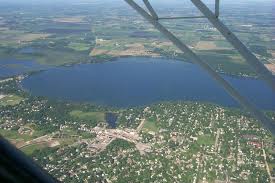
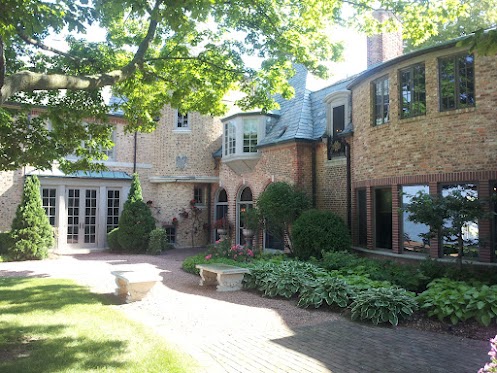
Check out this lakeside patio on LacLaBelle lake one of Wisconsin beautiful lakes.
This waterfront property is for sale at 800 N Lake Dr in OCONOMOWOC WI
by Lisa Bear of Remax.
Over 335 feet of sparkling frontage is just the
beginning. This lakefront luxury mansion on the great Midwest, near
Chicago is a retreat like no other. 30 rooms, 8 bedrooms, 15 bathrooms
and 7 fireplaces. One of the most luxurious homes in all of the Midwest
USA.
Priced at 5.4 million. Contact Lisa Bear at 262-893-5555 for
additional information.
 KNOLLWARD - A Marjorie Montgomery Ward Estate established in 1928
You have to see this one to believe it…
an encompassing 350 ft of prsitine frontage on Lac LaBelle
Rooms: 30 / Bedrooms: 8 / Bathrooms: 10.5 / Garage Spaces:4.5 / Sq Ft: 15,222
Price - MVP'd 4.9 to 5.4 million
Imagine gables roofs, dormers,
oriel, French Provincial windows, black marble, wrought iron, cypress
beams, gold plating and turreted outlines framing 355feet of Lac La
Belle lake shore. Picture traveling through 30 rooms with seven
fireplaces and 17 chandeliers in a time still suspended in the year
1928.
Now
picture yourself owning incredible KNOLLWARD; the former summer home
of Marjorie Montgomery Ward Baker, a monument paying tribute to an
unsurpassed era of glamour, grace and style.
Marjorie
Montgomery Ward Baker was the adopted daughter and only child of
Aaron Montgomery and Betty Ward. Aaron Montgomery Ward was the
founder of the nationally known mail order firm and first “wishbook.”
Commanding the east bank of Lac La Belle, the mansion is located at 800 N Lake Road, Oconomowoc. Known for its picturesque lakes and historical integrity, Oconomowoc captures the beauty of small town America (USA) combined with the sophistication of metropolitan Milwaukee just 30 miles east.
The story of Knollward is as fascinating as the house.
Aaron Montgomery Ward
was born on February 17, 1844 in Chatham, New Jersey. When he was
about nine years old, his father, Sylvester Ward, moved the family to
Niles, Michigan, where Aaron attended public schools. He was one of a
large family, which at that time was far from wealthy. When he was
fourteen, he was apprenticed to a trade to help support the family.
According to his brief memoirs, he first earned 25 cents per day at a
cutting machine in a barrel stave factory and then stacking brick in
a kiln at 30 cents a day.
Energy
and ambition drove him to seek employment in the town of St. Joseph,
a market for outlying fruit orchards, where he went to work in a
shoe store. Being a fair salesman, within nine months he was engaged
as a salesman in a general country store at six dollars per month
plus board, a considerable salary at the time. He rose to become head
clerk and general manager and remained at this store for three
years. By the end of those three years, his salary was one hundred
dollars a month plus his board. He left for a better job in a
competing store, where he worked another two years. In this period,
Ward learned retailing.
In 1865, Ward located in Chicago,
worked for Case and a lamp house. He traveled for them, and sold
goods on commission for a short time. Chicago was the center of the
wholesale dry-goods trade.
In
the 1860s Ward joined the leading dry-goods house, Field Palmer
& Leiter, a forerunner of Marshall Field & Co. He worked for
Field for two years and then joined the wholesale dry-goods business
of Wills, Greg & Co. In tedious rounds of train trips to southern
communities, hiring rigs at the local stables, driving out to the
crossroads stores and listening to the complaints of the back-country
proprietors and their rural customers, he conceived a new
merchandising technique: direct mail sales to country people. It was a
time when rural consumers longed for the comforts of the city, yet
all too often were victimized by monopolists and overcharged by the
costs of many middlemen required to bring manufactured products to
the countryside. The quality of merchandise also was suspect and the
hapless farmer had no recourse in a caveat emptor economy. Ward
shaped a plan to buy goods at low cost for cash. By eliminating
intermediaries, with their markups and commissions, and drastically
cutting selling costs, he could sell goods to people, however remote,
at appealing prices. He then invited them to send their orders by
mail and delivered the purchases to their nearest railroad station.
The only thing he lacked was capital.
After
several false starts, including the destruction of his first
inventory by the Great Chicago Fire, Ward started his business at his
first offices at the corner of North Clark and Kedzie streets, with
two partners and using $1,600 they had raised in capital. The first
catalog in August 1872 consisted of an 8 by 12 in. single-sheet price
list, showing 163 articles for sale with ordering instructions. Ward
himself wrote the first catalog copy. His two partners left the
following year, but he continued the struggling business and was
joined by his future brother-in-law Richard Thorne.
In
the first few years, the business was not well received by rural
retailers, who considered Ward a threat and sometimes publicly burned
his catalog. Despite the opposition, however, the business grew at a
fast pace over the next several decades, fueled by demand primarily
from rural customers who were attracted by the wide selection of items
unavailable to them locally. Customers were also attracted by the
innovative and unprecedented company policy of "satisfaction
guaranteed or your money back", which Ward began using in 1875.
Although Ward turned the copy writing over to department heads, he
continued poring over every detail in the catalog for accuracy. Ward
himself became widely popular among residents of Chicago, championing
the causes of the common folk over the wealthy, most notably in his
successful fight to establish parkland along Lake Michigan.
In 1883, the company's catalog, which became popularly known as the "Wish Book", had grown to 240 pages and 10,000 items.
In
1896, Ward acquired its first serious competition in the mail order
business, when Richard Warren Sears introduced his first general
catalog.
In
1900, Ward had total sales of $8.7 million, compared to $10 million
for Sears, Roebuck and Co., and the two companies were to struggle
for dominance for much of the 20th century. By 1904, the company had
grown such that three million catalogs, weighing 4 pounds each, were
mailed to customers.
In
1908, the company opened a building stretching along nearly 1/4 mile
of the Chicago River, north of downtown Chicago. (The building,
known as the Montgomery Ward & Co. Catalog House, served as the
company headquarters until 1974, when the offices moved across the
street to a new tower. It was declared a National Historic Landmark
in 1978 and a Chicago historic landmark in May 2000.)
At age 50, A. Montgomery Ward retired from the business a very wealthy man.
Seven years prior to his retirement, he came to Oconomowoc and purchased Colonel Durand’s three hundred acre horse breeding farm on the southwest corner of Lac La Belle,
in what is know the Mary Lane area and he named it La Belle Knoll.
For the next twenty years he carried on there an extensive horse
breeding operation and sold many horses. He also hitched them to his
elegant carriages and drove in numerous horse shows in the country,
acquiring a great number of trophies and ribbons.
The
Wards had no children, but in 1892 when Mrs. Ward’s sister died in
childbirth, they went to Michigan and adopted her daughter, who became
Marjorie Ward. As a small girl, she went along with her parents to
the International Horse Show in London, where her father won the
world champion trophy with his tallyho drag and team, a four horse
hitch, winning over the King of England and the Czar of Russia.
Ward
had a love for the city of Chicago and fought for the poor people's
access to Chicago's lakefront. In 1906 he campaigned to preserve
Grant Park as a public park. Ward twice sued the city of Chicago to
force it to remove buildings and structures from Grant Park and to
keep it from building new ones. Ward is known by some as the "watch
dog of the lake front" for his preservationist efforts. As a result,
the city has what is termed as the Montgomery Ward height
restrictions on buildings and structures in Grant Park. (However,
Crown Fountain and Jay Pritzker Pavilion were exempt from the height
restriction because they were classified as works of art and not
buildings or structures.) Ward is said to continue to rule and
protect Grant Park from his grave.
In
1909, while the Wards were at their California winter home, the home
on the La Belle Knoll estate burned to the ground, but the stables
remained unharmed. Mr. Ward returned to Oconomowoc,
but he never rebuilt a home there. Instead he rented a double suite
at Draper Hall Hotel and each morning he bicycled out to the stables
to watch the coachman working with the horses. In 1911, he drove a
Modoc four cylinder touring car, which was sold by his company.
In
late 1913 Ward broke his leg, and death soon followed. He died at
the age of 69. Ward willed $20 million to his widow, Betty, and $2
million to his adopted daughter Marjorie.
In 1926, the Simmons property, with 700 feet of Lac La Belle frontage, came on the market. This land is where KNOLLWARD now stands. Mrs. Ward purchased it and had the existing buildings razed.
Mrs.
Ward engaged architects and builders to erect the gracious mansion
at a cost of $80,000 just before the country sunk into Depression.
The elegant touches that such money bought are evident from the
moment you set your eyes upon it. It was considered the finest
example of French-Provincial Manor type architecture in the Midwest
and still carries a reputation as a “Showplace of the Midwest”.
It
took two years to build, and when it was finished, Mrs. Ward and
Marjorie were in California. They returned to the Midwest, but before
they got to Oconomowoc, Mrs. Ward died at their Chicago home. So,
Marjorie came to live at Knollward, given the name of the family home
on the other side of the lake, which had burned.
Marjorie,
by all accounts, lived a fairy-tale life at the mansion. She filled
the dream house with treasures such as 17 crystal chandeliers, walnut
paneling in the salon, a marble bathroom, seven fireplaces (all
real, emblazoned with the Ward coat of arms), Cyril Colnik
wrought iron and gold plated telephones and faucets, a private
telephone booth, fountains, garden frescoes and even a miniature
marble tub for her dog. She imported students from the Chicago Art Institute to hand paint walls and even the ceiling of her bathroom.
The
elder Wards did not give many parties, but Marjorie didn’t share her
parent’s aversion to social whirl. She became famous for
entertaining the glittering folk of Hollywood, kings and politicians.
Her housewarming skills were memorable. She hired a nine piece band,
minstrel singers, and a cabaret show. Chicago caterers served 200
guests on Crown Derby and Dresden china. Small tables were set up on
the lantern-lit patio all around the grounds. And there were other
parties, too. A Gypsy Party for one hundred and fifty guests had two
bands, fortune tellers giving out favors, acrobats, and clowns. And
then, of course, there were those affairs where guests were in formal
attire and arrived at the front door in black limousines.
In 1932, Marjorie married Robert Baker, an Oconomowoc
man whose family “made their money in coal.” The couple met in 1913,
but all four of the couple’s parents disapproved of this match, so
the courtship was a long one. They waited for the demise of all their
parents before marrying, at which time they were both forty years
old.
The
Baker’s built an addition to Knollward, an elegant wing for the
mister, including the master bedroom suite, library, curved halls,
turrets, spiral staircase and his own front door. The Zebra Lounge, a
party lounge complete with black and silver art deco-style fireplace
was also added under the library along with a tunnel through which
the butler replenished the liquor supply unobtrusively (during the
Prohibition era.)
The Bakers spent time at Knollward,
living most of the winter and spring in Chicago, until Marjorie’s
death in 1959. Her will stipulated that her husband could use the
mansion during his lifetime. Instead he moved to Chicago. He died, at
age 85, in Bronxville, NY.
After
he moved out the estate became property of the Montgomery Ward
Foundation, which was offered to the Milwaukee Episcopal Archdiocese
first, and then to the City of Oconomowoc as a library and civic
center. The gift was valued at $300,000. Lutheran Homes of Oconomowoc was
a willing recipient in 1961, as long as the home was used as a home
for elderly people for 25 years. The Foundation’s gift included fund
for construction of a new two story wing to match the original
exterior, remodeling and decorating.
By
the early 1990’s, government guidelines and restrictions caused
Lutheran Home to build a new building, Shorehaven Tower, across the
lake. It opened in 1996. Thus, Knollward was put up for sale and
purchased in June 1997.
In
1997, with new owners and a vision to “get it back to what it was”, a
complete renovation began to restore the integrity and bring the
house into the modern century. The house needed a complete overhaul,
including a new electrical system, new plumbing, new mechanicals,
including the entire heating system and the addition of air
conditioning. About 9,000 square feet of hardwood and marble floor
also needed refinishing. Further, because it had last functioned as a
retirement home and the graciously sized rooms had been subdivided
to create more bedrooms, multiple wall partitions needed to be torn
down.
A
symbol of beauty in a bygone era, the existing owners also updated
the kitchen and baths with modern facilities while maintaining the
revel and character. The original detailed ironwork of the world
famous Cyril Colnik remains, as do the fountains, urns, the original
Montgomery Ward coats of arms, as well as many of the chandeliers,
sconces, and marble floors.
Now
in 2010, Knollward becomes available to a new family who will
appreciate the splendor and history of this estate. Knollward, with
its 30 some rooms (50 if you count baths and storage areas)
encompasses 15,222 square feet, boosts 8 bedrooms, 10.5 bathrooms,
4.5 car garages located on 335 feet of sparkling frontage on Lac La Belle in Oconomowoc which offers exquisite lake views, crystal clear waters and gorgeous sunsets.
Today’s value is estimated at between 4.5 and 5.5 million

Welcome to Wisconsin Real Estate with Lisa Bear
Thank you for visiting. Please feel free to
contact me for any of your real estate needs including an
online market if you are a
seller, or
finding a home if you are a
buyer. My real estate focus in the
Waukesha County,
Milwaukee County,
Lake Country,
Jefferson County,
Dodge County and
Washington County
areas. I have my IRES designation (International Real Estate
Specialist) so I can assist you with all your real estate needs in
Wisconsin, the USA or anywhere in the
WORLD!
When you are seriously looking or just browsing at
real estate in Wisconsin, I am a great resource to help you with all your needs and questions, whether a
first time home buyer,
relocating to or from the beautiful
LAKE COUNTRY area, looking to invest or
explore foreclosure opportunities or just thinking ahead to the future.
The
prospering communities of
Waukesha County including
Delafield,
Waukesha,
Oconomowoc,
Pewaukee,
Waukesha,
Sussex,
Wales,
New Berlin,
Dousman,
North Prairie,
Mukwonago,
Chenequa,
Menomonee Falls,
Brookfield,
Elm Grove,
Okauchee,
Eagle,
Muskego and
Merton.
Great municipalities in Milwaukee County including
Milwaukee,
South Milwaukee,
Wauwatosa, Hales Corners, Greenfield, Glendale, Franklin, Bayside, Brown Deer, Cudahy,
Fox Point, Greendale, Shorewood, Oak Creek, St. Francis, West Allis and Whitefish Bay.
The
hometown favorites of Washington County, Jefferson County and Dodge County including
Watertown, Hartford, West Bend, Germantown, Jackson, Richfield, Ashippun, Lake Mills, Jefferson, Johnson Creek, Slinger and Erin.
Real Estate in Wisconsin is an excellent investment!

"HELPING YOU MOVE IN THE RIGHT DIRECTION"